
Aerodynamically-driven rupture of a thin liquid film
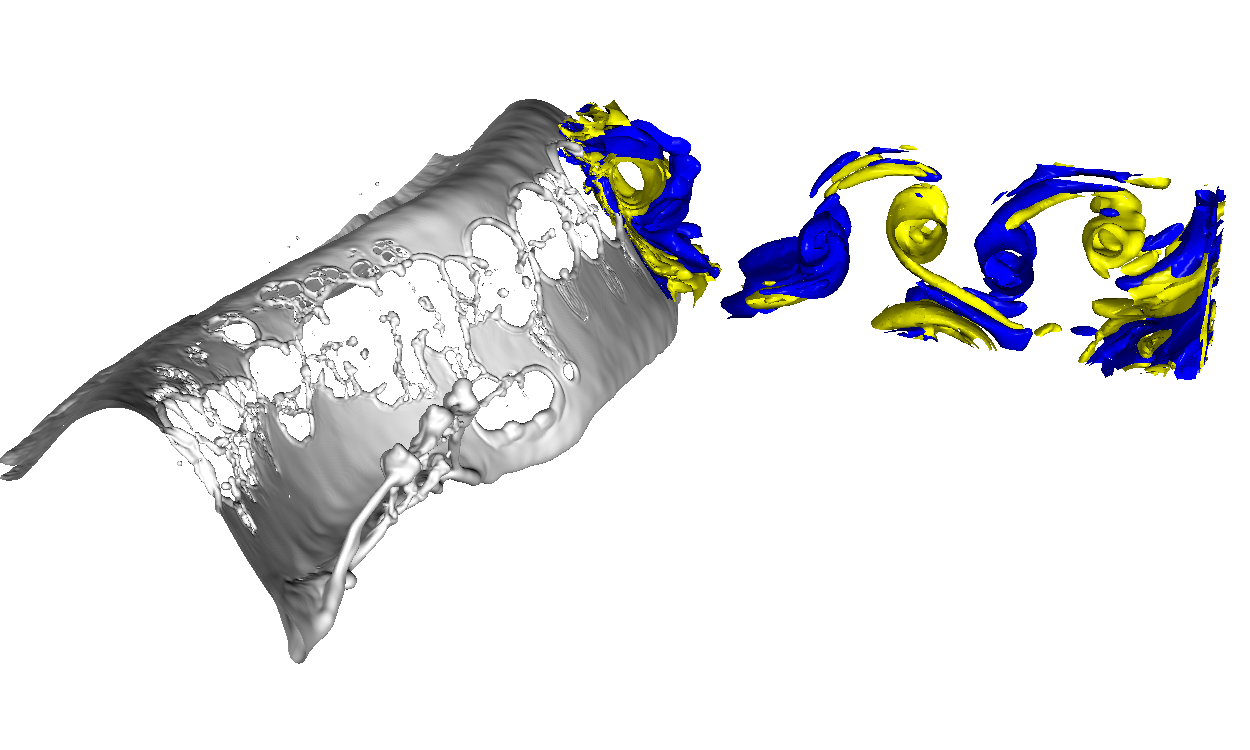
Liquid jet atomization is an important physical process that determines the droplet’s size and distribution and therefore the spray dynamics. A common understanding of the liquid atomization is based on the shearing instability and the acceleration of the liquid layer due to the difference in velocity with the surrounding gas stream. However, the main breakup can occur through flapping, hole formation and disintegration of thin liquid sheets initially formed (Jerome et al. 2013). Instead of large computations of the full liquid jet atomization, we are working on the dynamics of a thin liquid sheet surrounded by a fast gas stream. The objective of this study is to determine how the fast gas dynamics affect the liquid sheet flapping, holes formation and disintegration.

Breakup of thin liquid sheets through holes collision
Holes formed in a thin liquid sheet expand in time due to capillary force and form a toroidal rim at their free end. The rims retract due to surface tension and after a short transient reach a quasi-stationary regime with a constant velocity, where most of the dynamics consists of a slow increase of the rim size. This stage is referred to as the Taylor–Culick regime. We are working on the collision of these holes and the dynamics of the resulting ligament which subsequently breaks into droplets. The number of produced droplets and their size distribution as a function of initial characteristic scales will be elucidated.
Onset of three-dimensionality in the wake of cylinders
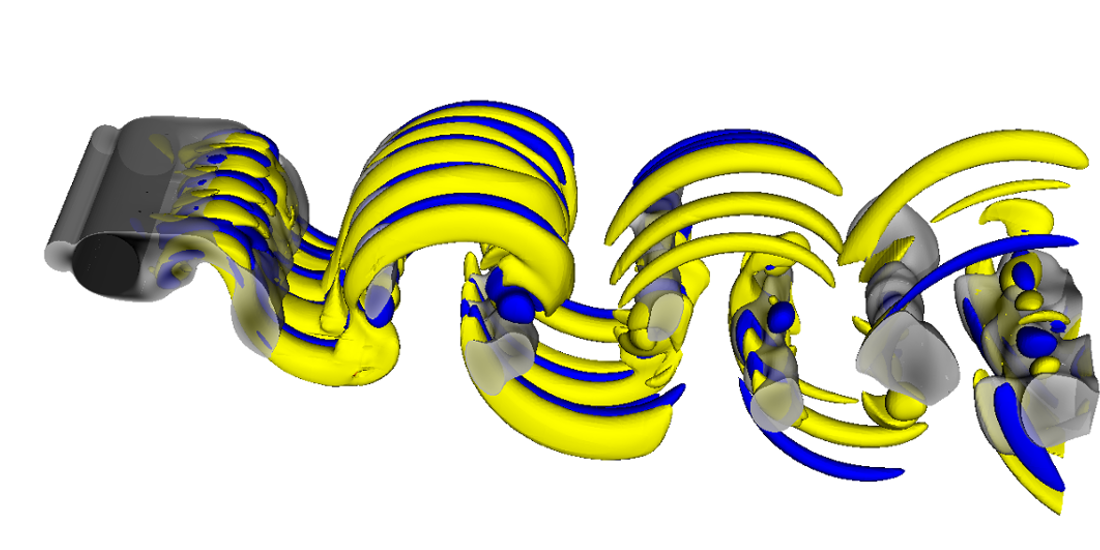
The flow past a solid obstacle has been the object of many previous studies because it is encountered in numerous industrial applications. The wake of bluff bodies, especially cylinders, is subject to two-dimensional von Kàrmàn vortex shedding when the associated Reynolds number is larger than a threshold value. At higher Reynolds numbers, the wake becomes unstable to three-dimensional disturbances. We are working on understanding the physical mechanisms responsible of the three-dimensional wake instabilities and the dynamics of the formed streamwise vortical structures.
Extended DG method for simulating liquid atomization
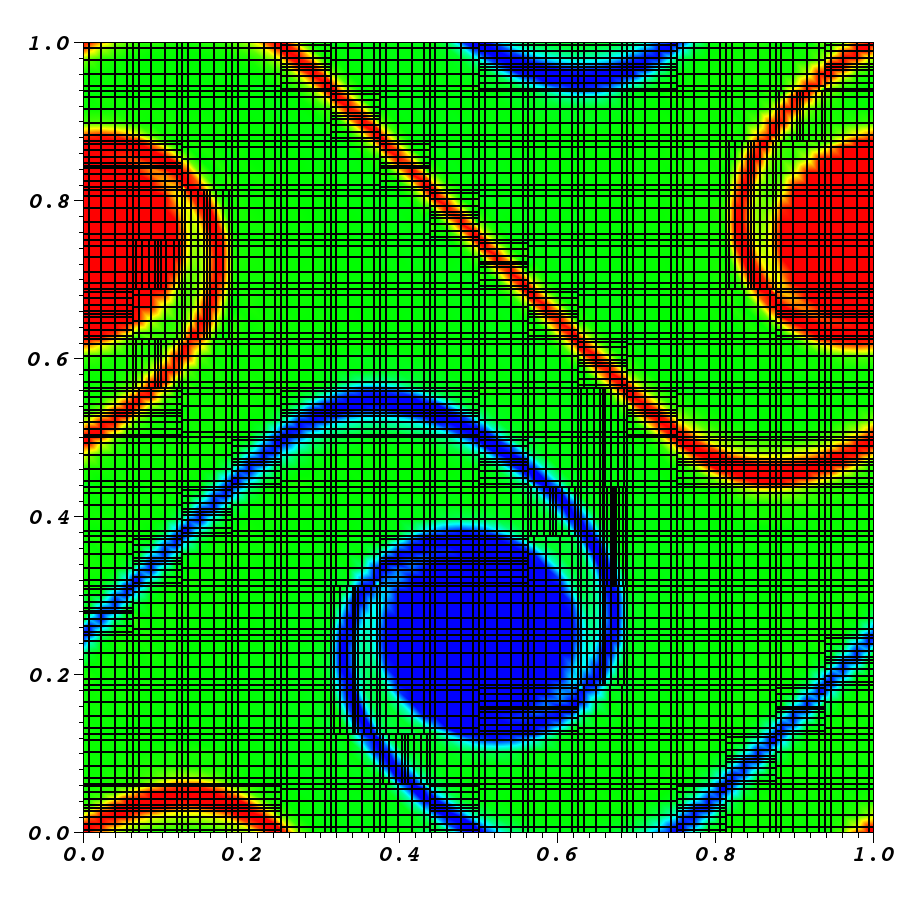
One of our group’s research goal, is to conceive a numerical framework that will allow for a parametric, fast and robust, numerical simulations of liquid atomization. Recently, we proposed a parallel hp-adaptive high order Discontinuous Galerkin (DG) method to solve the incompressible Navier-Stokes equations. In particular, the well known unstable case of a shear layer roll-up problem is easily calculated with this framework for high Reynolds numbers (103 − 105), see figure on the left. We are currently working on extending this framework for the simulation of two-phase flows.